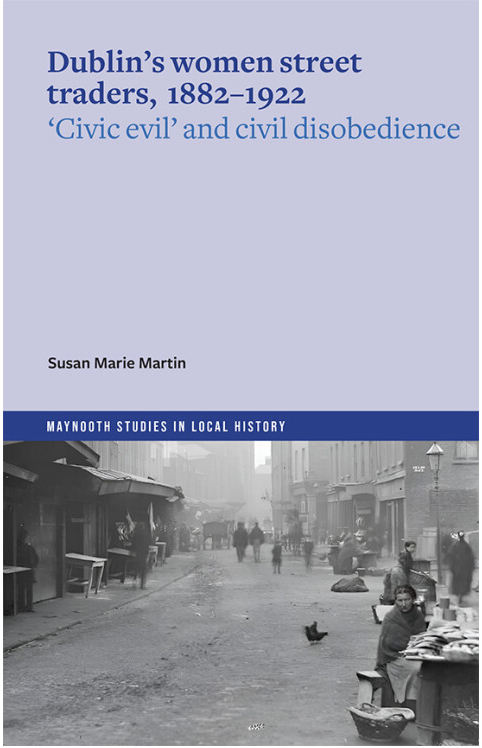
Dublin’s Women Street Traders, 1882-1932: ‘civic evil’ and civil disobedience (Four Courts Press)
A ballad about a woman street trader is widely regarded as Dublin’s anthem, yet the city’s relationship with those who traded on its streets was often acrimonious. From 1882 onwards efforts commenced to have street traders banned alongside gentrification projects. A watershed came with the passage of the Street Trading Act of 1926. This book examines the resistance of the traders when those with power refused to recognize them as stakeholders. What the establishment learned was that the women were prepared to engage in civil disobedience, endure violence from Gardaí and serve time in jail to both protect their livelihoods and protest what they characterized as ‘banishment to the slums’.
Reviews and Interviews
“This is a rigorously researched book, yet it has something of a cat-and-mouse quality to it as Susan Marie Martin skilfully sums up the attempts by the Street Traders’ Act to corral and regulate traders, and how those affected fought back to protect their livelihood.” Clodagh Finn, Irish Examiner, 20 December 2025
“The resistance of the street traders was formidable as the women were prepared to engage in civil disobedience, endure violence from Gardaí and imprisonment to protect their livelihoods and to vindicate their rights as actual ‘stakeholders’. Their story mirrors others around the world today, their courage is inspiring.” Ireland’s Genealogical Gazette, November 2025.
“Martin packs a great deal of social and political history of a kind that is little known, often quite unknown to some I expect…But the lesson of the whole story is one of civil resistance against the over heavy administration. The civil disobedience expounded by Thoreau and Gandhi came to Dublin’s ‘streets broad and narrow.’” The Irish Catholic, 6 November 2025.
“Susan Marie Martin’s research had shone a bright light on the inner city, and especially, on the ways in which women were treated both before independence and afterwards.” Women’s History Association Ireland Book Reviews
The City – Interview with Susan Marie Martin (November 2025)
Bookline with Teresa Quinn on Liffey Sound 96.4 FM (4 January 2026)
Available at Four Courts Press, Books Upstairs, The Gutter Bookshop, O’Mahony’s, Kenny’s and Easons, and in Canada at Indigo and Amazon.
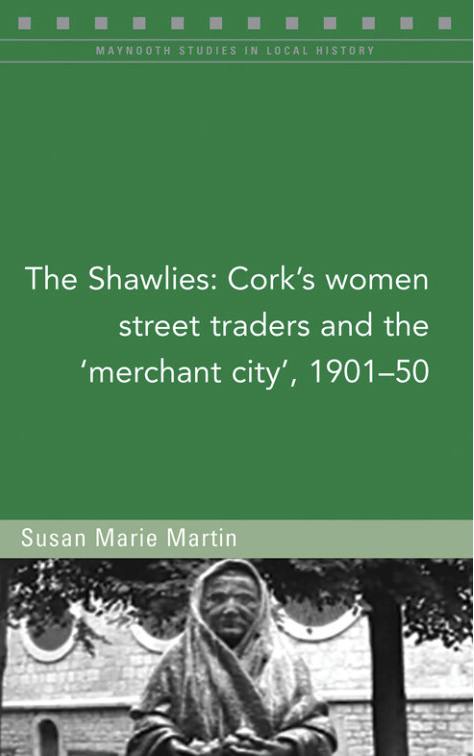
The Shawlies: Cork’s women street traders and the ‘merchant city’, 1901–50 (Four Courts Press)
For centuries, working-class Irish women survived as street traders, selling fruit, vegetables and second-hand clothing. In Cork they were known as ‘the Shawlies’ because of the distinctive, traditional black shawls they wore on the streets late into the 20th century. Their role was central to life and trade in the open marketplace of Corn Market Street, known locally as ‘the Coal Quay’. In the months following the establishment of the Irish Free State, the wholesale grocer, Musgrave Brothers Ltd, wanted to expand its operations and build a new facility on Corn Market Street. The firm exerted pressure on the local authority in Cork to ban street trading. In 1926, the Irish Free State government introduced the Street Trading Act, insisting it was fair legislation needed to regulate street trading. In practice, it limited the rights of the Shawlies to earn, and facilitated their disappearance from the streets. This study assembles the first narrative of the lives of the Shawlies, and places it within the story of the larger strategies of governance that came to shape Cork’s urban landscape.
Reviews
“Put simply, it is the story of how official society consistently conspired to make life as hard as possible for women who were already destitute. It is a story of both class and gender.” History Ireland, Nov/Dec. 2017
“…a fascinating aspect of Cork’s local history that is probably little known outside Cork city, however, it is much more than that, it is an important social history that may have its parallels in other parts of the State … highly recommended reading”, Ireland’s Genealogical Gazette (2017).
“Local studies, such as Susan Marie Martin’s examination of the ‘shawlies’ in Cork, emphasise the potential of microhistories and case studies and the benefit of using local sources to reveal the reality of working-class entrepreneurial activities like street trading in fruit, vegetables and second-hand clothing.” Irish Historical Studies, 46(170), 338-355.
“For Martin, while this was by no means a golden age for the Cork shawlies—the census material she marshals to show the subsistence income it brought most of them proves this comprehensively—when compared to the regime ushered in post-1922, it at least offered them space in which to trade, whether on the streets or in small open-air markets.” Journal of the Cork Historical and Archaeological Society, Vol. 123, 2018.
